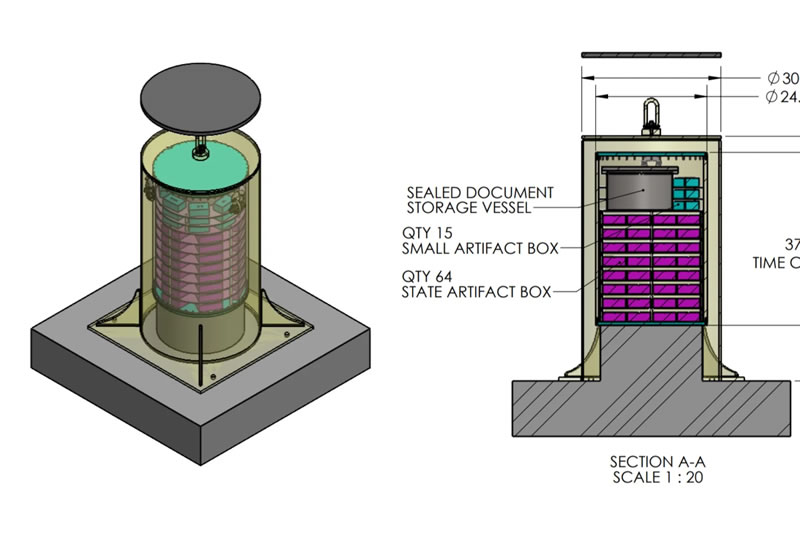
 On July 4, 2026, America250 will bury the Semiquincentennial Time Capsule within Independence National Historical Park in Philadelphia. The stainless steel cylinder, designed by the National Institute of Standards and Technology, is designed to safely store commemorative objects for 250 years until the capsule’s opening on July 4, 2275. Capsule contents are being collected from all three branches of the federal government, all 50 States 5 Territories and Washington DC, and the U.S. Semiquincentennial Commission and America250 events and programs.
A remarkable chapter in America250's story is nearly complete: America's Time Capsule has officially been sealed.
Created to commemorate the 250th anniversary of the signing of the Declaration of Independence, the capsule will be buried at Independence National Historical Park in Philadelphia on July 4, 2026, where it will remain until it is reopened in 2276.
Inside is a record of America at this historic moment, contributions from all 50 states, Washington, D.C., and five U.S. territories, along with items from all three branches of the federal government, America250 programs, and national partners.
Explore the Contents
What does America look like in 250 years?
The answers can be found in the stories, artifacts, innovations, and records preserved within the capsule, including:
-
Student artwork and essays from America’s Field Trip
-
Contributions from every state and territory representing local history, culture, and community life
-
Historic records and items from Congress, the Supreme Court, and the Executive Branch
-
Sports memorabilia reflecting the role of athletics in American culture
-
A groundbreaking DNA-based storage device from the Library of Congress containing digitized treasures from the nation’s collection
-
Objects representing American innovation, creativity, and everyday life in 2026
Developed in collaboration with experts from NIST, the Library of Congress, and the National Park Service, the capsule was carefully designed to preserve its contents for the next 250 years.
When it is opened in 2276, future generations will discover a snapshot of America at this historic milestone.

As America250 continues the countdown to July 4, 2026, America's Time Capsule stands as a lasting tribute to the people, ideas, and experiences that define our nation today.
Learn More
The CNMI America250 Commission submitted a hand-crafted sinåhi and lighatúttúr donated by CNMI Cultural Artists Emi Peter-Palican and Gordon "FIGO" Babauta Salas and a letter from the Honorable David M. Apatang as its contribution to the Semiquincentennial Time Capsule.
 |
 |
 |
 |
Carolinian Lighatúttúr
The Carolinian community takes pride in its creativity and its ability to use the natural resources around us to benefit
our people. Bead-making, for example, is an art that has existed since ancient times and is traditionally taught
through hands-on demonstration. Before modern beads were introduced, Carolinians chipped stones of different
colors into various shapes and strung them together using coconut or hibiscus fibers to create necklaces, chokers,
bracelets, earrings, and anklets. Divers searched the deep blue waters of these islands for the elusive red stone called
Fáái Paar, while others combed the beaches for smooth stones and shells whose colors and shapes could bring a
maker’s design to life.
This craft was never limited to stones and shells alone; nut shells from different trees were also used to create
ornaments. Today, beads are far more accessible, and the traditional methods of shaping and fastening them are less
common. Commercially produced beads—offered in many shapes, sizes, and colors—have made bead-making
easier. Even so, the creativity and spirit behind the practice remain rooted in the traditions of the Carolinian people.
Description and artifact produced by Emi Peter-Palican
 |
 |
 |
 |
Carolinian Lighatúttúr
The Carolinian community takes pride in its creativity and its ability to use the natural resources around us to benefit
our people. Bead-making, for example, is an art that has existed since ancient times and is traditionally taught
through hands-on demonstration. Before modern beads were introduced, Carolinians chipped stones of different
colors into various shapes and strung them together using coconut or hibiscus fibers to create necklaces, chokers,
bracelets, earrings, and anklets. Divers searched the deep blue waters of these islands for the elusive red stone called
Fáái Paar, while others combed the beaches for smooth stones and shells whose colors and shapes could bring a
maker’s design to life.
This craft was never limited to stones and shells alone; nut shells from different trees were also used to create
ornaments. Today, beads are far more accessible, and the traditional methods of shaping and fastening them are less
common. Commercially produced beads—offered in many shapes, sizes, and colors—have made bead-making
easier. Even so, the creativity and spirit behind the practice remain rooted in the traditions of the Carolinian people.
Description and artifact produced by Emi Peter-Palican